

I Graded a Competitor’s Local SEO Advice
Not long ago, I went back and graded some of my own SEO advice from 2019.
Some of it held up pretty well.
Some of it didn't.
That got me thinking. Why should I only pick on myself?
I recently came across an article from another Tucson SEO company titled “How Tucson Businesses Can Dominate Google’s Local Pack.”
Since local SEO is something I've been doing in Tucson for a long time, I decided to grade the advice.
To be fair, there is some perfectly good advice in the article. There is also some advice I disagree with, some claims I think need evidence, and one recommendation I absolutely would not give a client.
Let's get out the red pen.
Optimize Your Google Business Profile
Grade: A
The article starts with the basics: claim your profile, use the appropriate categories, keep your hours updated, add photos, and make sure your business information is accurate.
Yep.
It's not exciting, but it doesn't need to be.
Your Google Business Profile is enormously important for local search. Make sure the information is accurate and complete.
One minor complaint: the article still calls it Google My Business or GMB.
Google changed the name to Google Business Profile in 2021. So as of this writing, this advice is at around 5 years old.
I'm not taking off much for that. Plenty of us still accidentally call it GMB. Old habits die hard.
Get More Google Reviews
Grade: A
Also good advice.
Ask real customers for reviews. Make it easy for them. Send them the direct review link. Respond to reviews.
No argument from me.
Then things go a little sideways.
Offer Discounts or Gifts for Reviews
Grade: F-
That is such terrible advice that it changes the overall score of this. 0 points may God have mercy on your soul and etc.
The article recommends:
“Offer incentives like discounts or small gifts for leaving feedback (while complying with Google’s guidelines).”
There's a problem with the part in parentheses. This is the kind of advice that can put a Google Business Profile at risk.
Google's guidelines specifically prohibit offering incentives such as payments, discounts, free goods, or services in exchange for reviews.
You can ask customers for honest reviews. You can make leaving a review easy.
You cannot give somebody a discount or a free sandwich because they left you a Google review.
Adding “while complying with Google's guidelines” is an oxymoron.
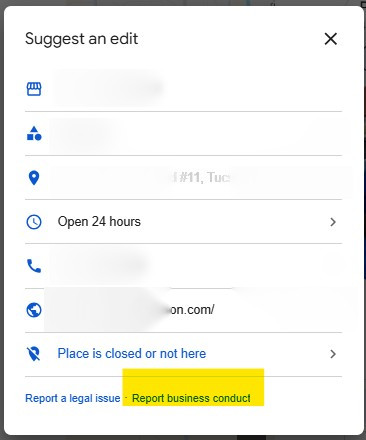
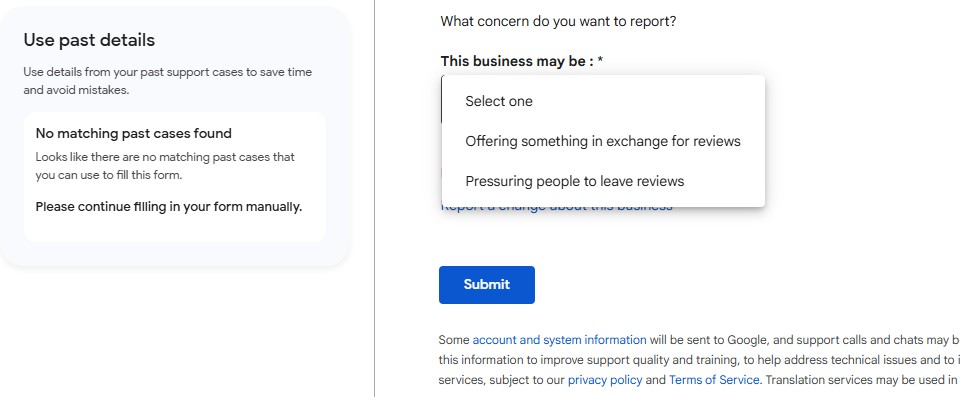
Google hates this so much that they make it super easy to report that someone is either offering incentive or harassing people into leaving reviews.
Build Local Citations
Grade: B
The article recommends getting your business listed with organizations and directories such as the Tucson Metro Chamber, Visit Tucson, Yelp, and the Better Business Bureau.
Yes.
Legitimate citations still have value, particularly because they help establish your business information around the web and can send actual customers to you.
Where I disagree is with this:
“The more consistent and widespread your citations, the more Google trusts your business.”
That's a much bigger claim. This sounds like local SEO advice from an era when agencies sold businesses packages containing hundreds of directory submissions.
I would rather have a business listed correctly on the handful of websites that actually matter than spend my afternoon trying to get it listed on grandbazaarofindia.com
Put Tucson Keywords Everywhere
Revised Grade: C+
Okay. I'm revising this one upward.
The article recommends using Tucson-related keywords in your website content, Google Business Profile, service pages, blog posts, meta titles, descriptions, and even customer reviews.
I originally gave this a D because there's an obvious point where local optimization turns into writing for a search engine instead of a human. I still stand by that part. If you're an electrician in Tucson, your website should make it obvious that you're an electrician in Tucson. You don't need to remind Google that you're in Tucson every other sentence.
However, there is something to be said for consistently reinforcing the geographic market you're trying to rank in.
And, I will be damned, Google recently decided that this very article was highly relevant for one of my Tucson SEO searches.
So apparently the article in which I criticized someone for saying "Tucson" too much may itself be benefiting from the fact that I say "Tucson" approximately five million times.
I'm not giving this advice an A. We're not bringing back 2-point keyword text at the bottom of the page. But I'm willing to admit I graded this one too harshly.
Revised grade: C+
Optimize for “Near Me”
Grade: D
Here's the recommendation:
“Optimize for Google’s ‘near me’ searches by using relevant phrases in your content.”
Please don't.
If you're writing:
Looking for an SEO company near me? Our SEO company near me provides the best SEO services near me!
I'm going to come over and take your keyboard away.
Google understands location considerably better than it did 15 years ago.
Build a website that clearly explains what you do and where you do it. You don't need to awkwardly insert “near me” into your copy to convince Google that somebody standing three miles away is near you.
Post to Your Google Business Profile Every Week
Grade: D
Posting to your Google Business Profile is fine.
Have a promotion? Post it.
Have something useful to announce? Post it.
New service? Holiday hours? Interesting project?
Go for it.
Where I have a problem is this claim:
“Posting at least once a week signals to Google that your business is active and relevant.”
Show me the evidence for this. I see plenty of businesses rank that haven't posted on that thing in 5-6 years.
There's a difference between something being useful for customers and something being a Local Pack ranking factor.
If you've got something worth posting, post it.
I would not tell a small-business owner that they need to manufacture a Google Business Profile post every Tuesday because Google is waiting for an activity signal.
Get Tucson Backlinks
Grade: C
Yes good.
Relevant local links can be extremely valuable.
Sponsor a legitimate Tucson organization. Join an organization you actually participate in. Get mentioned by local media. Build relationships with other businesses.
Those are real links associated with the community where you actually operate.
The article loses a few points for recommending that businesses:
“Partner with local businesses and exchange links.”
Link to eachother if it makes sense, but “let's exchange links for SEO” isn't a link-building strategy I'd recommend.
Exchanging links directly back and forth can cancel each other out. And if all those backlinks are coming from websites sitting on the same IP address, yeah you are totally getting one over on them! 😂
Earn links because there is a legitimate reason for another website to reference your business.
Earn links because there is a legitimate reason for another website to reference your business.
Make Your Website Fast and Mobile Friendly
Grade: A+
Yes.
It's 2026.
Your website should work on a phone. It should also load quickly.
Slow clap like I gave myself for my old advice.
Track What Is Actually Happening
Grade: A
The article recommends Google Analytics, Google Search Console, BrightLocal, and Moz Local.
Sure.
Personally, Search Console is one of the first places I look when I'm trying to understand how a website is performing organically.
And if you're doing local SEO, you need to remember that Maps rankings change based on where the person searching is located.
A single ranking check from your office doesn't tell you what the entire Tucson market sees.
So What's the Final Grade?
I'm not actually giving one. Or maybe I did in the hero image.
Most of this article isn't bad advice. Some of it is good. Some is generic. Some of it presents SEO assumptions as established facts.
And offering customers discounts or gifts in exchange for Google reviews is something you simply shouldn't do.
That's actually the larger reason I wanted to write this.
SEO advice gets repeated.
One person writes something. Another person rewrites it. Ten agencies turn it into a “Local SEO Checklist.” Eventually something that may have started as a theory becomes accepted wisdom because everybody has read it somewhere.
I've been guilty of it too.
That's why I went back and graded my own SEO advice from 2019.
The important question isn't whether an SEO company has ever published something wrong.
If you've been doing this long enough, you probably have.
The important question is whether you're willing to go back, look at what you said, compare it with what we know today, and occasionally say:
Yeah. I wouldn't recommend that anymore.