
SEO
I Graded My Own SEO Advice From 2019. Some of It Was Terrible.
I've been doing SEO long enough that I occasionally get the opportunity to argue with a younger version of myself.
While rebuilding the Tucson SEO Pros website, I dug through the old site from 2019. Some of the advice holds up surprisingly well. Some of it was very much a product of SEO at the time.
And some of it makes me want to find the guy who wrote it and ask what the hell he was talking about.
Unfortunately, I know where he lives.
So let's grade my own SEO advice from 2019.
Content Search Engine Optimization
Here's what I told prospective clients in 2019:
This often entails writing content that is laced with strategically placed, industry-specific keywords. These are the same words that Google scours the web for on its quest to provide relevant answers to a given search query. If your website doesn't contain the correct keywords, it's a signal to search engines that your business doesn't matter. But here's the catch: If you use too many of the exact same keywords, Google quickly concludes you're trying too hard, and that your site is "conning" its algorithms, and it punishes you.
Optimal keyword usage includes proper word positioning with a disciplined, but not too rigid, frequency of selected words that are well placed in proper context and proximity to secondary keywords.
When this is done with precision, you will rise in the eyes of Google.
Grade: D
Good lord.
"Proper word positioning." "Disciplined frequency." "Proximity to secondary keywords."
This makes SEO sound like we're sprinkling magical keyword fairy dust across the page according to a secret formula.
I don't think that way anymore.
Search engines have gotten dramatically better at understanding language. We have found that natural writing, depth of knowledge, and actually answering the searcher's question matter considerably more than trying to achieve some theoretically perfect keyword density.
There's no magical fairy dust or algorithm that any human being alive can tell you will exactly match Google's search criteria. If there were, we'd all know it and exploit it. Then Google would know we were exploiting its secret sauce, change it, and might even penalize the people who followed the recipe too exactly.
I still care about keywords. I just care much more about what the person using those keywords is actually trying to find.
How Content Affects Rankings
Google can read how many words there are on a page. If you are using too few words to describe yourself, Google will see it as being "light on content." You generally want a minimum of 900 words on the page to be taken seriously, and they can't just be filler. They need to be targeted toward what term you are trying to rank.
Grade: D
Ah yes. At least 900 words.
It got insane for a while there.
SEO companies were looking at competing pages, counting words, and concluding that if the page ranking above yours had 1,400 words, clearly we needed 1,700.
I don't believe there is some magical minimum anymore.
A page should be long enough to genuinely answer the search intent. Sometimes that's 500 words. Sometimes it's 2,000. A complicated subject may need considerably more.
Genuine information, useful recommendations, firsthand knowledge, examples, and actual answers are what I'm after now. I'm not adding another 400 words because an SEO tool wants to turn a little circle from orange to green.
Also, content that is informative and highly relevant tends to get more backlinks.
Yep. Still true.
More on those backlinks in a minute.
We also strongly believe that simply blogging to check it off as a monthly or weekly to do list item is a waste of time, at best. At worst, unrelated blog entries can actually bring rankings down. Blogs should serve to reinforce what the site is about, while also gaining additional profit centers.
Grade: A-
Give this man a cookie. He was onto something.
I still don't believe businesses need to publish something every Tuesday because somebody once told them Google rewards "fresh content."
Your blog should reinforce the main content of your website and answer the longer, more specific questions that don't belong on your primary service pages.
What about this particular situation? How do I fix this problem? What's the difference between these two options? What happens if I do this instead?
Those are useful reasons to write.
"It's Tuesday and our content calendar says we need a blog post" isn't.
If Content Is King, Then Backlinks Are the Queen of SEO
Apparently we all talked like this back then.
Deliberately placed keywords are critical, but all by itself, even high-powered, precisely written content won't propel you to the top, at least it won't in competitive environments. Tucson SEO Pros also acquires authoritative, niche relevant backlinks to build the trust of Google.
10 years ago the strategy for backlinks was, "the more the better." It really didn't matter if they were relevant or not. Now Google assesses the relevance of the sites that link to you. Too many unrelated backlinks can actually send you backwards.
We spend countless hours scouring spreadsheets targeting the best backlinks for your business.
Grade: F
Yeah. Yikes.
The spreadsheet guys? Google knows who they are. You're not getting one over on them.
There was an entire industry built around finding websites willing to sell links and guest posts, measuring their supposed authority, putting everything into enormous spreadsheets, and acquiring links from sites that looked sufficiently powerful.
We played that game too.
We don't anymore.
You will get precisely nada from me for a package of 20 paid guest posts on "high-authority" websites whose primary reason for existing seems to be selling high-authority guest posts.
The cat caught that mouse.
We may still manually search for legitimate directories, industry organizations, associations, suppliers, and related websites where inclusion actually makes sense.
But no more guest post spreadsheets.
Sorry.
What's Trust Got to Do With SEO?
Google didn't get to be Google by believing everything it's told. The brains behind the curtain at search engines around the world are aware of our services, and others like them. In order to serve their searchers the best selections, search engines look for credibility factors.
So even though you wouldn't jump off a bridge no matter how many of your friends did, Google is programmed to make decisions in exactly that manner.
Much of this boils down to industry jargon. Domain Authority, page authority, trust flow, citation flow.
Grade: C
Domain Authority, Page Authority, Trust Flow, and Citation Flow aren't Google metrics. They're third-party attempts to estimate something considerably more complicated.
They can still have uses. They can help with comparisons and research. But Google has its own systems.
We have ways of looking at the available evidence and making educated guesses about what Google thinks of a website. After doing this for a long time, some of those guesses can become pretty well educated.
They're still guesses.
If somebody tells you that Google ranks your competitor higher because its Domain Authority is 43 and yours is 31, ask them where Google published that formula.
I'll wait.
Local Tucson Traffic
Not all clicks are created equally. Tucson SEO Pros focuses on getting you the clicks that are poised to become customers. 80,000 unique visitors a day is all for nothing if 99 percent of them are from Shanghai and Nova Scotia.
Grade: C-
The basic idea isn't completely wrong. If your goal is generating customers in Tucson, 100 visitors who actually need your service can obviously be worth more than 10,000 completely irrelevant visits.
But I was way too dismissive of traffic simply because it wasn't local.
Today, if someone in Nova Scotia finds one of my articles useful, great. It probably means I wrote something useful enough to reach well beyond my local market.
Informational content doesn't suddenly become worthless when someone crosses the Arizona state line.
Shanghai bot farm hitting /wp-login.php 40,000 times?
You can still leave.
Keyword Research
Tucson SEO Pros stays up-to-date on the latest industry-related research to keep you out in front of online marketing trends. We learn about your business, identify the necessary keywords you need to rank highly for, audit your current online situation, make a plan, roll up our sleeves, and then we get to work.
Grade: B
This is basically still true.
What has changed is how I think about the keywords themselves.
I want to know what people search for. I want to know which terminology customers actually use. I want to understand the questions surrounding the main query and, most importantly, what someone typing that query actually wants.
But I'm considerably less worried about exact-match wording.
I can use synonyms. I can phrase something naturally. I can even misspell something, which my poor business partner will know is an important technological advancement for me.
Search engines have gotten much better at understanding what a page means instead of simply matching strings of words.
Less can be more.
More is usually more, though, provided the more consists of genuinely useful content containing real expertise rather than another 700 words of SEO soup cooked up to hit a word count.
So How Does Google Weigh Expertise?
That's my proprietary SEO GURU™ secret sauce.
Just kidding.
I don't know exactly.
Neither does the person trying to sell you their 47-point proprietary E-E-A-T optimization system.
We can study results. We can read what Google tells us. We can test changes. We can compare sites. We can watch what happens across different clients and industries. After enough years, you develop some fairly well-informed opinions.
But if I actually knew Google's exact ranking formula, I'm reasonably certain Sergey Brin would have me black-bagged and dragged into tunnels deep underneath Mountain View.
On-Page and Technical SEO
There are a number of tools online that will spit out a large amount of industry jargon telling you what it believes are your site's weak points. Many times these tools are correct.
Other things are not issues at all.
Yet those online tools will tell you those are issues, when they are not. You need someone who understands what these things mean.
Grade: A
This is still great advice.
I freaking hate it when AI gets ahold of SEO auditing tools.
Actually, I love it.
Because I actually know what all this stuff means.
Give an AI an SEO audit containing 436 warnings and it can very efficiently explain why you should panic about all 436 of them.
Give me the same report and I might tell you 390 don't matter, 30 are worth cleaning up eventually, 12 should be fixed, and four may actually be causing a problem.
An audit report isn't a diagnosis. Technical SEO requires understanding which problems can actually affect crawling, indexing, performance, or search visibility and which ones are mostly noise.
I'll chase all of it down because that's what you hired me to do. I'll fix plenty of little things too because I'm an anal-retentive completionist about websites.
But I'm also going to tell you when something probably doesn't matter.
No, Google probably does not care about the missing alt attribute on that decorative background image.
I'll fix it.
Your rankings probably won't move.
Sorry.
Some Other Things to Consider
MOBILE RESPONSIVE DESIGN: A website's appearance on a phone screen has surpassed the importance of its image on a desktop computer. More than half of internet traffic is now done on the go, responsive design is no longer a luxury, it's a requirement.
Grade: A, But Who Cares?
This is funny mostly because of when it was written.
There were still businesses running around with non-responsive websites. SSL wasn't completely universal yet. You could occasionally find a perfectly legitimate business website that looked like somebody had stuffed its desktop version through a 375-pixel-wide mail slot.
Today?
Of course your website needs to work on a phone.
I don't have much more to say about it.
So What Did 2019 Me Forget?
Page speed.
Accessibility.
Curious omissions.
So I ran the old Tucson SEO Pros website through Lighthouse.
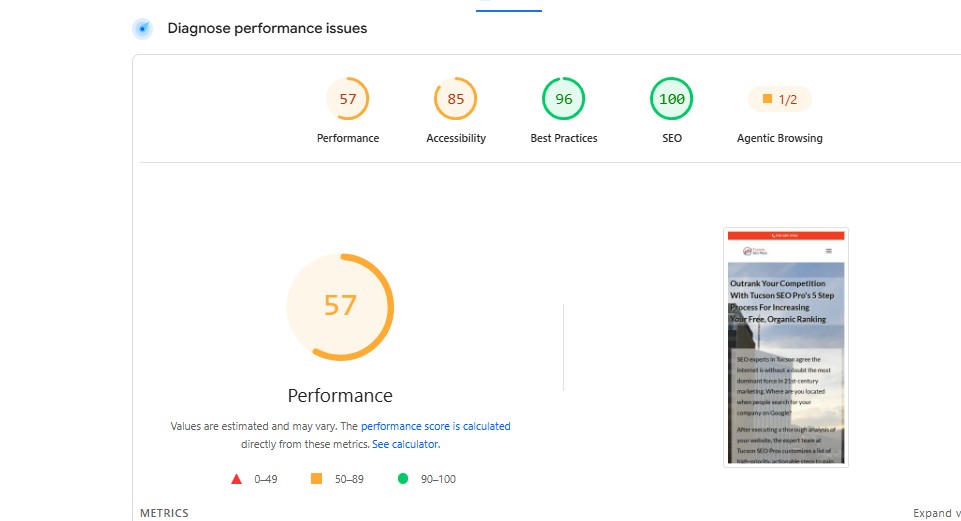
Performance: 57.
Ouch.
Accessibility: 85.
Not catastrophic, but we're not putting that one on the refrigerator.
Best Practices: 96.
Hey!
SEO: 100.
Naturally, the SEO guy gave himself a perfect SEO score.
Apparently I was extremely concerned about keyword proximity, backlink spreadsheets, and making sure every service page crossed an arbitrary word-count threshold while my own website was dragging a piano behind it.
I've gotten considerably more interested in performance since then.
The current Tucson SEO Pros site is tiny compared with the old WordPress installation. There's less JavaScript, less overhead, fewer things happening simply because some plugin decided they should happen, and considerably more direct control over what the browser actually loads.
It is faster.
It also came at a terrible price.
I am now working directly in HTML and CSS. I transfer files with FTP. I have strong opinions about unnecessary JavaScript. I've caught myself getting excited because I reduced cumulative layout shift.
I grew a neck beard and began disdaining WordPress.
Final Grade: C
That's actually better than I expected.
Some of this aged terribly. Some of it was conventional SEO wisdom that I no longer believe. A surprising amount of it still holds up.
The biggest difference is that I spent much more time in 2019 thinking about how to manipulate measurable signals: keyword frequency, word counts, backlinks, and authority scores.
Today I spend much more time thinking about whether a page is genuinely useful, demonstrates that somebody actually knows the subject, satisfies the search intent, works properly, loads quickly, and gives search engines a clear understanding of what it's about.
So congratulations, 2019 me.
You passed.
Barely.
Now go fix your 57 performance score.
Was it worth it?
Ask me again after I spend three hours looking for a missing </main> tag.